Spelling Bee: Spelling Quiz
- 4.6
- Rating
- 500.00K
- Installs
- Free
- Price
 Analysis by App-foxy
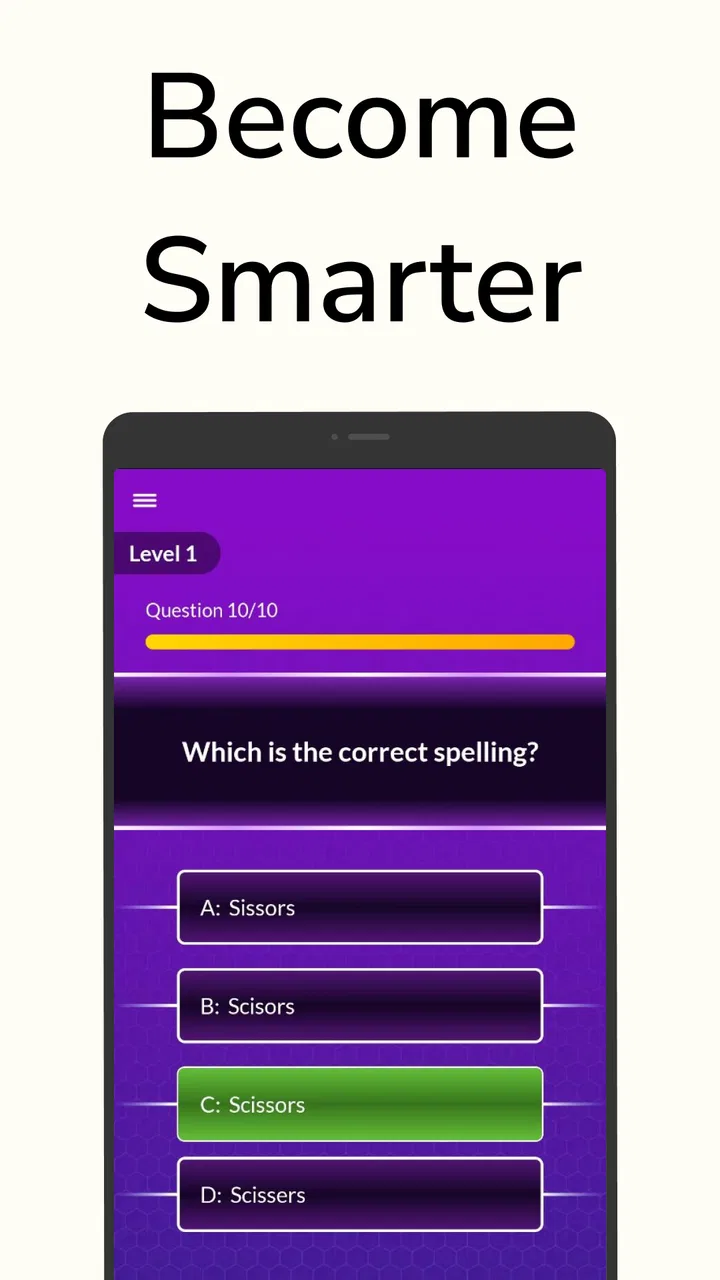
I found Spelling Bee: Spelling Quiz most useful as a quick language-training game rather than as a complete English course. It turns spelling practice into short trivia-style challenges, so I can open it when I have a few spare minutes instead of committing to a long lesson. The idea is simple, but that simplicity is also the reason it works best for a particular kind of player: someone who wants repeated word practice, immediate mental effort, and a more playful alternative to studying from a list.
Happy-verse presents it as a free game for improving English spelling, and my experience matches that central purpose. It is aimed at Everyone, runs on Android devices from 5.0 onward, and has reached over 500 thousand installs. Those details make it accessible to a broad audience, including younger learners and people using an older phone. There are in-app purchases ranging from $4.90 to $19.00 per item, so the free starting point is appealing, although anyone who dislikes optional spending should pay attention before committing to extended use.
How the current game feels in everyday use
The strongest part of the experience is its low barrier to entry. I do not need to prepare a study plan or decide which word list to revise. I can simply begin answering spelling questions and let the game provide the exercise. That makes it a natural fit for a morning routine, a short break, or a few minutes before bed when I want something more constructive than endlessly scrolling.
You May Also Like

 Blood Strike: 2.5 Anniversary
Blood Strike’s Loadouts Turn Every Drop Into a Tactical Gamble
A close look at Blood Strike’s custom loadouts: how fast access to signature weapons reshapes its battle royale rhythm, rewards preparation, and narrows the gap between fights.

 Pandora - Music & Podcasts
Pandora’s Music Is Easy to Start, but Harder to Recover
Pandora’s strength is its low-effort path from a seed to a station. Its weak spot is how much confidence it asks you to place in connection, setup, and quiet recovery.

 8 Ball Pool
 Is Built on Rivalries, Rematches, and Routine
A close look at the rivalries, rematches, shared routines, and unanswered safety questions that turn a quick pool match into a persistent mobile community.

 Samsung Music
’s Quiet Strength Is Playing What You Already Own
Its reach comes less from spectacle than from dependable access to a personal library. That simplicity is both the app’s strongest retention engine and its ceiling.

 AccuWeather: Weather Radar
AccuWeather Review: A Quick, Clear Forecast for Everyday Decisions
For everyday plans, the best forecast is the one you can understand quickly. AccuWeather makes rain timing, radar, and local conditions easy to act on, with a few trade-offs.

 Hill Climb Racing
Why Hill Climb Racing Still Turns Crashes Into One More Run
A tiny car, a bumpy hill and one more upgrade: Hill Climb Racing keeps resurfacing because its simple chaos makes every near-miss feel personal.
More From Our News Desk
View All News


A realistic use case would be a student waiting for a bus. Instead of opening a full educational platform that may require an account, a lesson path, or a longer session, the student can use this game for a compact burst of spelling practice. The same approach works for an adult who understands spoken English but regularly hesitates over written words. Repeatedly choosing or entering the correct spelling can help make familiar patterns easier to recognize.
I would not describe the game as a replacement for reading, writing, conversation practice, or a dictionary. Spelling questions isolate one skill. They can show me whether I recognize the correct form, but recognition is not always the same as being able to use a word naturally in a sentence. That distinction matters if the goal is broader English improvement.
The trivia format gives the practice a lighter feel than a traditional worksheet. I am more likely to return to a game that feels quick and approachable than to a static list of words, especially when my concentration is limited. At the same time, players who want detailed explanations may find the format too narrow. The value comes from repetition and attention, not from lengthy teaching around every answer.
Who will get the most from it
This is a good match for beginners, casual learners, parents looking for an age-appropriate word activity, and fluent speakers who want to sharpen spelling. It can also suit people who learn better through small challenges than through memorization. Because it is categorized as trivia, the experience feels closer to testing myself than following a formal classroom sequence.
I think it is particularly useful for learners who make recurring spelling mistakes but do not know which words to practice first. A quiz can expose those weak spots naturally. My practical advice is to keep a small note of words that cause trouble, then revisit them outside the game by writing a sentence for each one. That turns a quick round into a more complete learning routine.
It is less suitable for someone seeking pronunciation coaching, grammar lessons, vocabulary definitions, or advanced writing feedback. A dedicated language-learning app will usually be better for structured progression, while a dictionary will be better when I need a reliable definition, example sentence, or usage distinction. Choosing this game makes sense when spelling itself is the priority.
What the developer’s update history suggests
The current version is 5.7, while the game was released on May 11, 2022. That combination suggests a product that has continued beyond its initial launch rather than remaining frozen at its first release. I see the version number as evidence of ongoing maintenance, but not as proof that every part of the experience has been redesigned. A later version can reflect refinements as well as larger changes, and I would avoid assuming more than that.
For existing users, continued version development is reassuring because it indicates that the app has had an active life. It also means that someone returning after a long break may notice differences in presentation or behavior compared with the original release. The sensible approach is to judge the current build on its own merits rather than relying on impressions from the launch period.
The game’s average rating is 4.7 from around 3.5 thousand ratings, with over 200 written reviews. That is a strong reception and suggests that many players find the basic concept satisfying. I still would not treat the rating as a guarantee for every learner. A highly rated spelling quiz can be excellent for short practice while remaining unsuitable for someone who needs explanations, writing correction, or a complete curriculum.
One useful way to interpret the positive response is that the core loop is easy to understand. Players generally know what they are being asked to do, and the subject is immediately practical. The trade-off is that a straightforward loop can become repetitive if I expect the depth of a full language platform. The game’s continued appeal depends on whether I enjoy returning to focused spelling challenges.
How it affects people who already use it
For a regular player, the main benefit is consistency. Because the activity is small and familiar, it is easier to build a habit around it than around a demanding course. I would use it as a warm-up before writing an email, revising schoolwork, or working on English notes. The key is to treat each session as one piece of practice, not as a complete measure of language ability.
Existing users can also make the quiz more effective by slowing down on words that look almost correct. Spelling errors often happen when I answer quickly based on appearance. Taking a moment to identify the troublesome letter pattern, then saying or writing the word afterward, creates a stronger connection than simply tapping through a result.
Another practical workflow is to separate recognition from production. After answering a word correctly, I can cover the answer and write it from memory. If I only recognize the right option, I may feel confident without actually being able to spell it independently. This extra step is not a feature I would expect the game to replace; it is a way to extend the value of each question.
Families may also find the Everyone rating helpful when choosing a simple word activity, but supervision can still improve the learning outcome. A child may focus on winning or answering quickly rather than understanding the spelling pattern. Asking the child to explain which letters were difficult turns the game into a conversation instead of passive screen time.
Where the experience still has limits
The biggest limitation is scope. A spelling quiz can strengthen accuracy, but it does not automatically teach when a word is appropriate, how it changes in a sentence, or why similar words are spelled differently. If I am preparing for an exam, writing professionally, or learning English from the beginning, I would pair this with reading and guided instruction rather than use it alone.
There is also a motivational trade-off. Gamified practice can make repetition easier, but players who need a visible course structure may want clearer milestones and broader lesson variety. The short-session design is convenient, yet convenience can make it tempting to stop after answering questions without reviewing mistakes. I get better results when I deliberately turn errors into follow-up practice.
The optional purchase range is another consideration. The game is free to start, which lowers the risk of trying it, but purchases from $4.90 to $19.00 per item can matter to families or anyone managing a strict budget. I would recommend using the free experience first and deciding whether the additional value justifies spending. There is no reason to buy immediately simply because the game is enjoyable.
Older Android users should benefit from the stated minimum requirement of version 5.0, but device age can still affect comfort, screen readability, or general responsiveness. I would test it on the actual phone that will be used for study, especially if it belongs to a child or is shared by several people. Compatibility is one question; everyday convenience is another.
How it compares with familiar alternatives
Compared with paper flashcards, this game is more immediate and less effortful to start. I do not have to create a deck before practicing. Flashcards still have an advantage when I want total control over the exact words, such as vocabulary from a school chapter or a professional field. The game is better for spontaneous practice; cards are better for targeted revision.
Compared with a dictionary, it encourages active recall rather than passive lookup. A dictionary is indispensable when I need meaning, pronunciation, usage, or an example. This game is more engaging when I already want to test myself. Using both can work well: quiz first, then consult a dictionary for words that remain confusing.
Compared with a full language-learning course, the game is faster and less intimidating, but much narrower. A course is the better choice for grammar, listening, speaking, and a planned progression. I would choose this app when I want a focused spelling tool that can fit around another method, not when I expect one download to cover every part of English.
Compared with ordinary trivia games, it offers a clearer educational purpose. The questions are tied to spelling rather than general knowledge, so the practice is relevant even when I am not in the mood for a serious lesson. The compromise is that players who mainly want entertainment may find the subject repetitive, while learners may wish for richer explanations after an incorrect answer.
Small habits that make each round more useful
I recommend avoiding rushed tapping. Before answering, I try to picture the whole word and notice the part that feels uncertain. If I get it wrong, I write the correct spelling once, then use it in a short sentence. This takes little extra time but addresses the weakness of quiz-only learning: recognizing an answer without being able to produce it.
It also helps to use the game at a consistent point in the day. A short session after breakfast can function as a mental warm-up, while a round before homework can identify words worth reviewing. The important part is not turning it into a stressful obligation. Its advantage is accessibility, and an overly rigid routine would remove that benefit.
For adults, I would connect the practice to real writing. After a session, I might review an email, a note, or a draft and look for words with similar spelling patterns. For children, I would ask them to create a sentence or draw a simple association. These methods give the quiz context without pretending that the game itself provides every language skill.
What to watch as the product continues
The most important thing for future users is whether ongoing development keeps the core activity fresh while preserving its simplicity. Since the game has moved from its 2022 release to version 5.7, I would watch for improvements that make mistakes more educational, not merely changes that alter the appearance. Clearer learning feedback would make repeated use more valuable for serious learners.
I would also pay attention to how well the experience serves different levels. Beginners need approachable words and encouragement, while stronger spellers need enough challenge to avoid boredom. A good balance would let the same player continue using the game as confidence grows. Without that balance, users may enjoy the first sessions but eventually move to more advanced tools.
Another point worth watching is the relationship between the free experience and the optional purchases. The game’s free entry is one of its strongest advantages, so the decision to spend should feel like a choice rather than a requirement for basic usefulness. That matters especially for families and casual learners who only need occasional practice.
My overall view is positive, with clear boundaries. Happy-verse has made a focused spelling game that is easy to approach, suitable for Everyone, and convenient for short bursts of English practice. I like it most as a companion to reading, writing, or a broader language course. Its real strength is turning a small amount of spare time into active spelling practice, not replacing a complete education.
If you want a free starting point for testing your spelling, this is worth trying. If you need grammar instruction, pronunciation work, detailed explanations, or a carefully staged curriculum, I would choose a more comprehensive alternative and use this game only as a supplement. For the right player, its focused design is a benefit; for someone expecting an all-purpose English teacher, it will feel limited.
In the end, I would recommend it to a friend who wants a light but purposeful word challenge. I would suggest beginning with the free option, practicing slowly enough to learn from mistakes, and pairing difficult words with real sentences. That approach respects what the game does well while avoiding the common mistake of expecting a spelling quiz to teach every part of English.
FAQs for Spelling Bee: Spelling Quiz
01What age group is Spelling Bee: Spelling Quiz suitable for?
Spelling Bee: Spelling Quiz is designed for users of all ages, from children learning to spell to adults looking to enhance their vocabulary. The app offers various difficulty levels, making it adaptable for different age groups and skill levels. Parents can also use it as an educational tool for their kids.
02Does Spelling Bee: Spelling Quiz require an internet connection to play?
No, Spelling Bee: Spelling Quiz does not require an active internet connection for most of its features. Users can enjoy a majority of the spelling challenges offline. However, certain features such as leaderboards or updates may require internet access to function properly.
03Are there any in-app purchases or ads in Spelling Bee: Spelling Quiz?
Yes, Spelling Bee: Spelling Quiz includes in-app purchases that allow users to unlock additional features or remove ads. While the app is free to download, these purchases help enhance the gaming experience by offering more content or an ad-free environment. Users can enjoy basic features without spending money.
04How does Spelling Bee: Spelling Quiz help improve spelling skills?
Spelling Bee: Spelling Quiz uses interactive quizzes and challenges to engage users in learning. It provides immediate feedback on spelling attempts, allowing users to learn from mistakes. The app also includes a variety of word categories and difficulty levels, which helps users progressively improve their spelling skills and vocabulary.
05Can I track my progress in Spelling Bee: Spelling Quiz?
Yes, Spelling Bee: Spelling Quiz features a progress tracking system that records your scores and achievements. This allows users to monitor their improvement over time. The app also offers the ability to compare your performance with friends or other players worldwide through leaderboards, adding a competitive edge to the learning experience.
Pros
- Engaging and fun for all ages.
- Improves vocabulary effectively.
- Easy-to-use interface.
- Variety of difficulty levels.
- Regular updates with new words.
Cons
- Ads can be intrusive at times.
- Limited offline functionality.
- Some words are region-specific.
- In-app purchases can be pricey.
- Occasional bugs in word lists.

Spelling Bee: Spelling Quiz
Gallery